Reviewer Guidelines
Thank you once again for agreeing to review for CCN Proceedings.
In order to create a review process that yields the highest quality, as a grass-roots organization, we have adopted a system that is more common at machine learning conferences.
As this is the second CCN Proceedings track, the timeline and guidelines may evolve. We appreciate your understanding and patience as we develop this new process for CCN.
Role
As a Reviewer, you carry the important responsibility of evaluating submissions, thereby identifying work that should be included and highlighted at CCN as well as giving feedback to others' work that is vital to the scientific process.
Each submission to the CCN 2026 Proceedings will receive at least 3 high-quality reviews from Reviewers like yourself. After the review period concludes, the Authors can respond to the reviews and sustain discussion with the Reviewers. Your work and that of your fellow Reviewers will be supported by an Area Chair (AC). The AC will write a meta-review that summarizes the reviews and discussions and makes a recommendation for acceptance. Your area chair will be supervised by a Senior Area Chair (SAC). Your communications with authors, other reviewers, and area chairs will take place via OpenReview.
OpenReview Console
The OpenReview console provides an overview of all papers assigned to you (for Reviewers and (S)ACs) or submitted by you (for Authors). From the console, you can access the forum page for each submission to view details, post comments, and engage in discussions. For a quickstart on the OpenReview forum page, see Using the New Forum Page.
Working in OpenReview
OpenReview supports Markdown and LaTeX formatting in text fields such as reviews,
comments, and rebuttals. You can use standard Markdown syntax for structure and
inline LaTeX (e.g., $x^2$) for mathematical notation.
Save your work locally
Do not rely on the OpenReview console to store your work in progress. OpenReview has some autosave functionality, but it may not persist. Draft your reviews, responses, and comments in a local file before submitting them on OpenReview.
Setting comment visibility
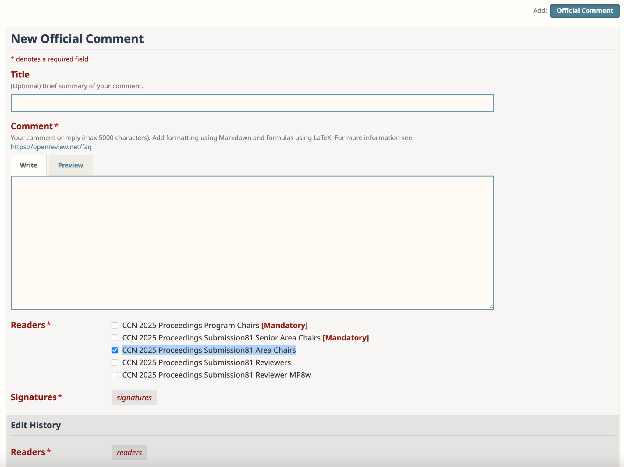
To set comment visibility in OpenReview, use the "Readers" dropdown when posting your comment. Check carefully that the appropriate people can see the comment before posting. For example, to engage in private discussion with an AC or SAC, the comment should be set visible to the AC or SAC and "Program Chairs" only. (The "Program Chairs" on OpenReview are the CCN TPC.)
Timeline
| Period | Reviewer responsibilities | Dates |
|---|---|---|
| Enrollment | Reciprocal reviewers enroll in reviewer pool. | Feb 10 - Feb 12, 2026 |
| Assignment | Feb 13 - Feb 16, 2026 | |
| Adjustment | Feb 17 - Feb 23, 2026 | |
| Review | Reviewers submit reviews for assigned papers. | Feb 24 - Mar 23, 2026 |
| Response | Mar 27 - Apr 7, 2026 | |
| Discussion | Reviewers engage with authors and update reviews. | Apr 8 - Apr 14, 2026 |
| Meta-Review | Apr 15 - Apr 27, 2026 | |
| Decision | Apr 28 - May 11, 2026 |
Review
Feb 24 - Mar 23, 2026
Assignment
We have done our best to match reviewers with the most appropriate submissions. However, if you find that a manuscript assigned to you is too far outside of your area of expertise, or if you recognize a potential conflict of interest; please let your AC or the TPC know straight away so that we can re-assign the manuscript by posting a comment on the OpenReview forum for the submission with the readers set to your Area Chair and the TPC (see Setting comment visibility).
A conflict of interest arises when an author on one of your assigned submissions is a current or former advisor, family member, or close personal relationship, a current or recent collaborator, or someone who works in your current or recent immediate organization, or when you have a financial interest in the work.
In addition, please make sure that your OpenReview profile has your latest email listed and keep an eye on emails possibly landing in spam.
Review deadline
Mar 23, 2026, 11:59 PM Anywhere on Earth (AoE), is the reviewing deadline. We are counting on you to submit your review(s) on or before this date so that we can move onto the next step of the process.
Reciprocal reviewers
As stated in the submission guidelines, if you are a Reciprocal Reviewer (reviewing as part of a Proceedings submission) and do not submit all assigned reviews by the author response stage, the relevant submissions may be desk-rejected from the Proceedings track and may not be considered for Contributed Talk when converted to the Extended Abstracts track.
Review content
Reviewers are asked to evaluate submissions according to their interest, soundness, clarity, and confidence of expertise, and to provide comments on their evaluations.
Structure of a CCN Proceedings review
Title
A brief summary of the reviewer's perspective on the manuscript.
Ratings
Submissions are rated on the following criteria:
Interest: To what extent is this work relevant to the CCN community, in terms of scope and impact?
- 5: Landmark (contributions have transformative implications for multiple disciplines at CCN)
- 4: Broad (contributions have significant implications with interdisciplinary relevance)
- 3: Disciplinary (contributions have significant implications within one of AI, cognitive science, or neuroscience)
- 2: Incremental (contributions have minor implications for one of AI, cognitive science, or neuroscience)
- 1: Limited (contributions are out of scope for CCN, or are covered by prior work)
Soundness: Does the evidence support the claimed contributions? Are the right methods used?
- 5: Exceptional (establishes new standards of evidence for a field)
- 4: Compelling (rigorous, e.g., convergent evidence from multiple methodologies)
- 3: Convincing (appropriate methodology and evidence consistent with claims)
- 2: Incomplete (evidence only partially supports the claims, or more appropriate methods are not used)
- 1: Inadequate (lacks critical evidence, or has methodological flaws that undermine conclusions)
Clarity: Are the contributions clearly communicated?
- 5: Exceptional (understandable to all of CCN; highly reproducible; pedagogical)
- 4: Accessible (coherent; understandable beyond immediate subfield; reproducible)
- 3: Adequate (understandable to an expert audience)
- 2: Underdeveloped (hard to follow and/or missing key details)
- 1: Poor (difficult to understand even for experts in the subfield)
Confidence of Expertise: Do you feel confident in your ability to judge this work?
- 5: You are absolutely certain about your assessment. You are very familiar with the related work and checked the methodological and/or technical details carefully.
- 4: You are confident in your assessment, but not absolutely certain. It is unlikely, but not impossible, that you did not understand some parts of the submission, or that you are unfamiliar with some pieces of related work.
- 3: You are fairly confident in your assessment. It is possible that you did not understand some parts of the submission, or that you are unfamiliar with some pieces of related work. Methodological and technical details were not carefully checked.
- 2: You are willing to defend your assessment, but it is quite likely that you did not understand the central parts of the submission, or that you are unfamiliar with some pieces of related work. Methodological and technical details were not carefully checked.
- 1: You are unable to assess this paper.
Comments
10,000 characters. Reviewers explain their evaluations of the interest, soundness, and clarity of the submission and provide additional comments to the authors. Reviewers can incorporate Markdown and LaTeX into the comments section.
Comments should:
-
Summarize the manuscript's claims and approach
-
List the strengths and limitations of the manuscript
-
Cover the dimensions above (Interest, Soundness, Clarity) and motivate the rating. It can also be helpful to explain why a higher or lower rating is not appropriate
-
Note any questions for the authors, or requests to clarify something, that could be helpful for the authors when presenting the work at CCN
-
Make suggestions for improvement of the work
Things to flag
If you note any of the following in your submissions, please escalate them to your AC or the TPC by posting a comment on the OpenReview forum for the submission with the readers set to your Area Chair and the TPC (see Setting comment visibility).
Breaches of anonymity
If you find that the identity of the authors is revealed (e.g., names or affiliations can be found in the text, or in included or linked supplementary material), please escalate this to the TPC.
Ethical concerns
This includes, for instance, harm, injury, or unfair bias. If you notice unethical behavior involving authors or reviewers assigned to you, please escalate this to the TPC.
Dual submission
Submissions that are identical or substantially similar to papers that are under review, have been accepted to, or have been published in other archival conferences and journals should be deemed dual submissions. If you suspect a dual submission, please escalate this to the TPC.
Discussion
Apr 8 - Apr 14, 2026
Authors are invited to submit an author response by Apr 7, 2026, which may include a revision of the submission PDF and a text response to each review. After authors submit their author response, and before the end of the discussion period, you are required to update your review. This update is important because the Area Chair will look to your review (both the scores and your justification for them) to inform their meta-review and initial decision recommendation for a submission. We especially ask that you update your categorical evaluations for interest, soundness, and clarity to make them consistent with your assessment of the submission after the author response, for example if it has addressed some of your concerns.
You are also encouraged to post a Reviewer Reply to follow up on any last things that need to be clarified before you can update your review per the author response. If an author submitted a "Rebuttal" to your review, you will see a "Reviewer Reply" button on the bottom right of their Rebuttal. You can submit one Reviewer Reply per Rebuttal of up to 2500 characters. The authors can then follow up with one last "Author Reply."
Please note that all discussion notes for a submission are visible to its Senior Area Chairs, Area Chairs, Reviewers, and Authors. The TPC ("Program Chairs" on OpenReview) can view everything on the OpenReview console.
The discussion period closes on Apr 14, 2026, Anywhere on Earth. No new replies from either Reviewers or Authors can be submitted after this time.
Policies
Availability
Respect deadlines and respond to emails as promptly as possible. Make sure that your preferred email address is accurate in your OpenReview profile and that emails from noreply@openreview.net don't go to spam. Please ensure your availability and engagement during your active periods of work. If you will be unavailable (e.g., on vacation) for more than a few days during important windows (e.g., decision-making), please let the TPC know as soon as possible.
If you are unable to meet these expectations, please let your AC or the TPC know as soon as possible.
Kindness
It is important to acknowledge that personal situations may, in rare instances, lead to late or unfinished work. If you find yourself unable to complete your work on time, please communicate this as soon as possible. If you oversee others who are unable to complete their work on time, we encourage you to be considerate of their personal circumstances and be ready to pick up the slack in such cases. If necessary, make a backup plan, and be flexible to the extent possible. In all communications, exhibit empathy and understanding.
Confidentiality
Do not discuss, distribute, or use ideas, content, or code of the submissions. Reviews are double-blind; authors and reviewers do not know each other's identity. Maintain strict confidentiality for all review materials. Don't use, send, share, copy, or upload submission content (ideas, results, code) until publicly available. Never distribute submissions outside the OpenReview platform.
Use of artificial intelligence
Artificial intelligence (AI) may only be used by reviewers for assistance purposes, such as organizing your written text, polishing the language of your review, and clarifying concepts that you want to understand better. The scientific content of your review must stem from your own discernment; do not outsource your judgment to an LLM.
Separately, submission content (including text and figures, substantive paraphrases thereof, as well as ideas, results, code) must not be entered into any system that does not guarantee zero data retention as part of its terms of service, as this constitutes a breach of confidentiality (see above). The default consumer interfaces of ChatGPT, Claude, and Gemini do not guarantee zero data retention; when in doubt, do not upload or paste.
Note that polishing your review's language can still expose submission content if you paraphrase the manuscript. Either confirm your tool meets the confidentiality bar above, or limit AI assistance to portions of your review that do not concern the submission's content.
Conduct
Abide by the CCN Code of Conduct. Take part in an active, polite, and constructive manner.
Transparency
Please note that all reviews and meta-reviews of accepted papers will be made public.
Anonymization
Authors and other reviewers do not know your identity.
However, ACs do know your identity.
Interdisciplinarity
Keep in mind that a submission may have a greater affinity with a domain other than yours.
Flexibility
Despite our best efforts to plan this year's process, this is very much a recent endeavor, and therefore, the timeline and guidelines may shift now and then. So please keep an eye on our communications, and we ask for your understanding and patience as we keep developing CCN.
Contact Info
If you encounter a situation that you are unable to resolve on your own, please contact the Technical Program Committee (TPC) at tpc@ccneuro.org.
If the issue is a technical issue related to the OpenReview platform, email the OpenReview support team directly at info@openreview.net and CC the TPC at tpc@ccneuro.org.