Author Response Guidelines
Thank you for submitting your work to the CCN Proceedings track. In this document, we outline the Proceedings review and decision processes that are relevant to authors of submissions.
OpenReview Console
The OpenReview console provides an overview of all papers assigned to you (for Reviewers and (S)ACs) or submitted by you (for Authors). From the console, you can access the forum page for each submission to view details, post comments, and engage in discussions. For a quickstart on the OpenReview forum page, see Using the New Forum Page.
Working in OpenReview
OpenReview supports Markdown and LaTeX formatting in text fields such as reviews,
comments, and rebuttals. You can use standard Markdown syntax for structure and
inline LaTeX (e.g., $x^2$) for mathematical notation.
Save your work locally
Do not rely on the OpenReview console to store your work in progress. OpenReview has some autosave functionality, but it may not persist. Draft your reviews, responses, and comments in a local file before submitting them on OpenReview.
Timeline
| Period | Author responsibilities | Dates |
|---|---|---|
| Review | Feb 24 - Mar 23, 2026 | |
| Response | Authors write rebuttals and optionally revise PDF. | Mar 27 - Apr 7, 2026 |
| Discussion | Authors engage with reviewers. | Apr 8 - Apr 14, 2026 |
| Meta-Review | Apr 15 - Apr 27, 2026 | |
| Decision1 | Apr 28 - May 11, 2026 |
Response
Mar 27 - Apr 7, 2026
Reviews
Reviewers are instructed to submit reviews by Mar 23, 2026, AoE. This is followed by an emergency period of several days in which missing reviews are completed by emergency reviewers so that each Proceedings submission receives at least 3 quality reviews. Reviews are released to authors on Mar 27, 2026.
Review content
Reviewers were asked to evaluate submissions according to their interest, soundness, clarity, and confidence of expertise, and to provide comments on their evaluations.
Structure of a CCN Proceedings review
Title
A brief summary of the reviewer's perspective on the manuscript.
Ratings
Submissions are rated on the following criteria:
Interest: To what extent is this work relevant to the CCN community, in terms of scope and impact?
- 5: Landmark (contributions have transformative implications for multiple disciplines at CCN)
- 4: Broad (contributions have significant implications with interdisciplinary relevance)
- 3: Disciplinary (contributions have significant implications within one of AI, cognitive science, or neuroscience)
- 2: Incremental (contributions have minor implications for one of AI, cognitive science, or neuroscience)
- 1: Limited (contributions are out of scope for CCN, or are covered by prior work)
Soundness: Does the evidence support the claimed contributions? Are the right methods used?
- 5: Exceptional (establishes new standards of evidence for a field)
- 4: Compelling (rigorous, e.g., convergent evidence from multiple methodologies)
- 3: Convincing (appropriate methodology and evidence consistent with claims)
- 2: Incomplete (evidence only partially supports the claims, or more appropriate methods are not used)
- 1: Inadequate (lacks critical evidence, or has methodological flaws that undermine conclusions)
Clarity: Are the contributions clearly communicated?
- 5: Exceptional (understandable to all of CCN; highly reproducible; pedagogical)
- 4: Accessible (coherent; understandable beyond immediate subfield; reproducible)
- 3: Adequate (understandable to an expert audience)
- 2: Underdeveloped (hard to follow and/or missing key details)
- 1: Poor (difficult to understand even for experts in the subfield)
Confidence of Expertise: Do you feel confident in your ability to judge this work?
- 5: You are absolutely certain about your assessment. You are very familiar with the related work and checked the methodological and/or technical details carefully.
- 4: You are confident in your assessment, but not absolutely certain. It is unlikely, but not impossible, that you did not understand some parts of the submission, or that you are unfamiliar with some pieces of related work.
- 3: You are fairly confident in your assessment. It is possible that you did not understand some parts of the submission, or that you are unfamiliar with some pieces of related work. Methodological and technical details were not carefully checked.
- 2: You are willing to defend your assessment, but it is quite likely that you did not understand the central parts of the submission, or that you are unfamiliar with some pieces of related work. Methodological and technical details were not carefully checked.
- 1: You are unable to assess this paper.
Comments
10,000 characters. Reviewers explain their evaluations of the interest, soundness, and clarity of the submission and provide additional comments to the authors. Reviewers can incorporate Markdown and LaTeX into the comments section.
Comments should:
-
Summarize the manuscript's claims and approach
-
List the strengths and limitations of the manuscript
-
Cover the dimensions above (Interest, Soundness, Clarity) and motivate the rating. It can also be helpful to explain why a higher or lower rating is not appropriate
-
Note any questions for the authors, or requests to clarify something, that could be helpful for the authors when presenting the work at CCN
-
Make suggestions for improvement of the work
Text responses
Once reviews are released, you are invited to write an author response (AKA a "Rebuttal") to each individual review. To do this, you can write a response under each official review by clicking the button "Rebuttal" in the lower right corner of each review.
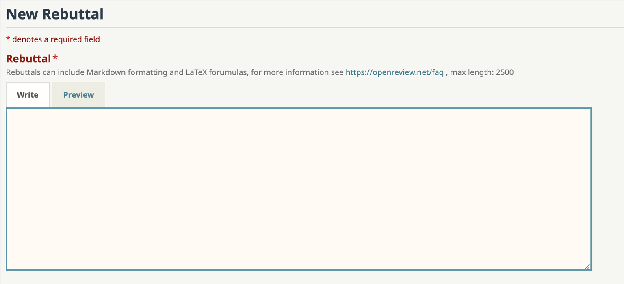
The deadline for submitting the text component of your author response is Apr 7, 2026. You must submit a text response before this date to participate in any follow-up discussion during the author-reviewer discussion period that immediately follows.
Each of these text responses has a 5000 character limit. Please ensure your responses are productive and respectful of the reviewer's opinions and time, and focus your response on critical concerns raised by the reviewers. You are not required to respond to every point in a review, and should focus on those that are critical for a reviewer's evaluation (see "Review content" above).
All reviewers for each submission will be able to see these responses, so it is fine to point a reviewer to a response written for a different review. For example, if two reviewers ask the same question, you can answer it in the response to one reviewer, and then ask the other reviewer to find the answer there.
PDF revision
In addition to the text response, authors are allowed, but not required, to submit a revised PDF based on reviewer comments. To do this, you can edit the submission PDF by clicking the button "Edit" then selecting "Author Response Revision". Note, however, that you should not add new results, unless directly requested by a reviewer (e.g., minor additional statistical analyses). Revisions can be uploaded as soon as reviews are released. The deadline for revising the submission PDF is the same as the text responses, Apr 7, 2026.
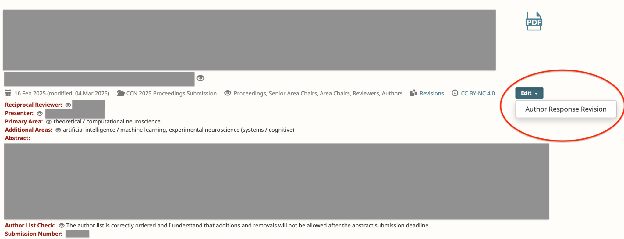
The 8-page limit still applies to the main text at this stage. If a reviewer requested methodological details for reproducibility that are difficult to fit into the main text, you may add these details to the supplement, and add a pointer in the main text. It can be helpful for reviewers to understand your revisions if you color added and/or revised text in blue or another non-black color (though you should also make sure that reviewers know how to interpret this style by explaining this in your text response).
Discussion
Apr 8 - Apr 14, 2026
After submitting your author response, which may include a revision of the PDF and a text response to each review, reviewers may post a "Reviewer Reply" to follow up on any remaining questions. If a reviewer replies to your rebuttal, you will receive an email notification and an "Author Reply" button will appear on the bottom right of their reply. You can submit one Author Reply per Reviewer Reply of up to 2500 characters.
Please note that rebuttals are not editable after the author response period closes on Apr 7, 2026. However, you may use your Author Reply to address any follow-up points raised by reviewers.
Please note that all discussion notes for a submission are visible to its Senior Area Chairs, Area Chairs, Reviewers, and Authors. The TPC ("Program Chairs" on OpenReview) can view everything on the OpenReview console.
The discussion period closes on Apr 14, 2026, Anywhere on Earth. No new replies from either Reviewers or Authors can be submitted after this time.
Decisions
Meta-reviews
Based on the reviews and the author rebuttals, ACs and SACs will write meta-reviews and recommend Proceedings paper rejection or acceptance, which will receive final review from the TPC and the PC. Decisions and meta-reviews will be released on May 12, 2026.
Furthermore, a small subset of accepted papers will be invited to present a Contributed Talk, which will be announced on Jun 26, 2026.
Invitations to Extended Abstracts
Authors of Proceedings submissions that are not accepted will be invited to convert their Proceedings submission to an Extended Abstract submission. Instructions for this will be provided at a later stage. There is no need to submit an Extended Abstract version of your Proceedings submission to the Extended Abstracts track.
Public reviews
Anonymized reviews and discussion will be made public on OpenReview for accepted papers only.
Policies
Conduct
Abide by the CCN Code of Conduct. Take part in an active, polite, and constructive manner.
Unprofessional or unethical behavior during the review and discussion process should be flagged to the AC via a private comment.
Contact Info
If you encounter a situation that you are unable to resolve on your own, please contact the Technical Program Committee (TPC) at tpc@ccneuro.org.
If the issue is a technical issue related to the OpenReview platform, email the OpenReview support team directly at info@openreview.net and CC the TPC at tpc@ccneuro.org.
-
Proceedings decisions are related to but not exactly the same as presentation format (poster) decisions at CCN 2026: accepted Proceedings papers will receive a poster; Proceedings submissions that are not accepted will go through another decision stage for the Extended Abstract track; all accepted Extended Abstracts will receive a poster, and we expect to accept all on-topic Extended Abstracts up to our venue capacity. For more details, see the call for papers. ↩