Area Chair Guidelines
Thank you for serving as an Area Chair (AC) for the second CCN Proceedings track!
In order to create a review process that yields the highest quality, as a grass-roots organization, we have adopted a system that is more common at machine learning conferences.
As this is the second CCN Proceedings track, the timeline and guidelines may evolve. We appreciate your understanding and patience as we develop this new process for CCN.
Role
As AC, your job is to ensure that all the submissions you are assigned have high-quality reviews and good discussions. You should become familiar with the contents of all your submissions and are responsible for making the initial decision recommendation in the form of a meta-review, with guidance from your senior area chair (SAC).
OpenReview Console
The OpenReview console provides an overview of all papers assigned to you (for Reviewers and (S)ACs) or submitted by you (for Authors). From the console, you can access the forum page for each submission to view details, post comments, and engage in discussions. For a quickstart on the OpenReview forum page, see Using the New Forum Page.
Working in OpenReview
OpenReview supports Markdown and LaTeX formatting in text fields such as reviews,
comments, and rebuttals. You can use standard Markdown syntax for structure and
inline LaTeX (e.g., $x^2$) for mathematical notation.
Save your work locally
Do not rely on the OpenReview console to store your work in progress. OpenReview has some autosave functionality, but it may not persist. Draft your reviews, responses, and comments in a local file before submitting them on OpenReview.
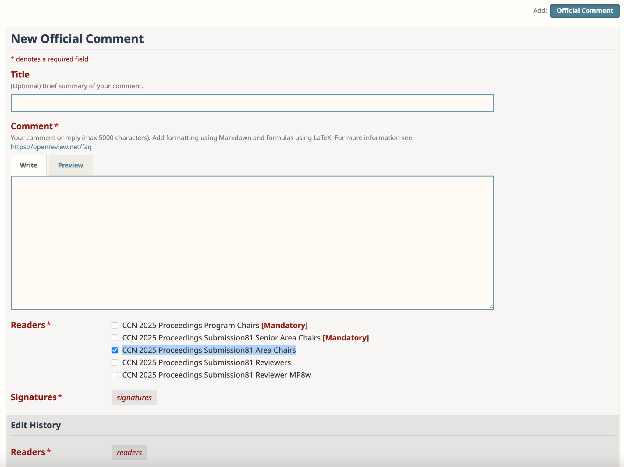
Setting comment visibility
To set comment visibility in OpenReview, use the "Readers" dropdown when posting your comment. Check carefully that the appropriate people can see the comment before posting. For example, to engage in private discussion with an AC or SAC, the comment should be set visible to the AC or SAC and "Program Chairs" only. (The "Program Chairs" on OpenReview are the CCN TPC.)
Timeline
| Period | AC responsibilities | Dates |
|---|---|---|
| Enrollment | Feb 10 - Feb 12, 2026 | |
| Assignment | Feb 13 - Feb 16, 2026 | |
| Adjustment | ACs check assignments. | Feb 17 - Feb 23, 2026 |
| Review | ACs facilitate reviewers writing reviews. | Feb 24 - Mar 23, 2026 |
| Emergency Review | ACs ensure all papers have 3+ reviews. | Mar 24 - Mar 26, 2026 |
| Response | Mar 27 - Apr 7, 2026 | |
| Discussion | ACs moderate discussion between authors and reviewers. | Apr 8 - Apr 14, 2026 |
| Meta-Review | ACs write meta-reviews. | Apr 15 - Apr 27, 2026 |
| Decision | Apr 28 - May 11, 2026 |
Adjustment
Feb 17 - Feb 23, 2026
We have done our best to match ACs with the most appropriate submissions. However, if you find that a manuscript assigned to you is too far outside of your area of expertise, or if you recognize a potential conflict of interest, please let your SAC or the TPC know straight away so that we can re-assign the manuscript by posting a comment on the OpenReview forum for the submission with the readers set to your Senior Area Chair and the TPC (see Setting comment visibility).
In addition, please make sure that your OpenReview profile has your latest email listed and keep an eye on emails possibly landing in spam.
During this period, also make sure that every submission in your batch is matched with suitable reviewers whom you can trust on this submission, ideally with a diverse set of opinions.
Review
Feb 24 - Mar 23, 2026
As an area chair, you will oversee the review process for the submissions assigned to you. Keep the process on schedule by following up with reviewers, assisting those who feel poorly matched, and finding replacements if necessary.
The reviewer pool is made up of Reciprocal Reviewers who are reviewing as part of a Proceedings submission, and Invited Reviewers who are volunteering their time. Reviews for both pools are due Mar 23, 2026. Read all reviews carefully. If a review is substandard, ask the reviewer to improve it with polite, concrete guidance. CCN expects the highest quality in its reviews, similar to a journal review, and reviewers are given a small load (on average, 2-3 papers) to make this possible. Please encourage this standard.
Things to flag
Reviewers are instructed to look out for the following in their submissions. If you note any of the below, please escalate them to your SAC or the TPC by posting a comment on the OpenReview forum for the submission with the readers set to your Senior Area Chair and the TPC (see Setting comment visibility).
Breaches of anonymity
If you find that the identity of the authors is revealed (e.g., names or affiliations can be found in the text, or in included or linked supplementary material), please escalate this to the TPC.
Ethical concerns
This includes, for instance, harm, injury, or unfair bias. If you notice unethical behavior involving authors or reviewers assigned to you, please escalate this to the TPC.
Dual submission
Submissions that are identical or substantially similar to papers that are under review, have been accepted to, or have been published in other archival conferences and journals should be deemed dual submissions. If you suspect a dual submission, please escalate this to the TPC.
Emergency Review
Mar 24 - Mar 26, 2026
During this period, ACs ensure that emergency reviewers and/or regular reviewers complete any tardy reviews so that each paper has at least 3 high-quality reviews before the start of the author response period.
Reciprocal Reviewers who do not complete their reviews by the reviews due date (Mar 23, 2026) will receive a warning from the TPC and be given the emergency review period to complete their review. If they still do not complete their review, the TPC will desk-reject their paper at the end of the emergency review period.
At the same time, the TPC will step in to assign an emergency reviewer to each paper that does not have at least 3 high-quality reviews by the reviews due date. As such, we ask that you as AC create a dialogue between yourself and the reviewers to aid the TPC in allocating emergency reviewers (e.g., if a reviewer will definitely submit a high-quality review during the emergency period, please let the TPC know to hold off on assigning an emergency reviewer).
The TPC is collecting a roster of emergency reviewers. If you have an ideal emergency reviewer in mind who can step in during this period and complete a review within 48 hours, please reach out to the TPC with their information, and we will assign them.
Discussion
Apr 8 - Apr 14, 2026
After the authors submit their Author Response, there is one week for discussion between authors and reviewers assigned to each paper. Facilitate a constructive discussion between authors and reviewers on OpenReview. Steer the discussion towards critical aspects of the submission and ensure it remains productive and respectful. Make sure reviewers update their reviews based on author responses, and that authors address critical reviewer concerns. You can follow up publicly or privately by restricting comment visibility.
Prompting reviewers and authors to engage during this period is valuable for you as AC, as it helps you collect the feedback and information you need to write an informed meta-review.
Meta-Review
Apr 15 - Apr 27, 2026
Write a meta-review for each submission that summarizes the reviews and discussion, and provides your decision recommendation ("Accept as Proceedings" or "Invite to Extended Abstracts") with justification. You can reach out to reviewers or the SAC for clarifications.
As an AC, we trust you to make an informed recommendation based on sufficient knowledge and justified analysis of the paper, and to clearly convey the reasoning to the authors.
Address and interpret any disagreements among reviewers and deliver a decisive recommendation. Deliberate with your SAC on borderline cases and on any recommendation that goes against the reviewers. The SAC will help you calibrate decision criteria across ACs.
Take a holistic approach: consider the strength of reviewer concerns and quality of reviews, not just scores or confidence estimates. Acknowledge the author's response, even if it didn't change the reviewers' concerns. If you overrule a unanimous reviewer opinion, your meta-review should meet the standard of a full review.
Much of our work will involve borderline papers where no one confidently expresses excitement, nor are any major problems identified. These are the tough decisions where we need your judgment!
Meta-review format
We ask you to provide the following in the meta review form on OpenReview:
-
Your CCN recommendation: "Accept as Proceedings" (accept full paper) or "Invite to Extended Abstracts" (reject full paper; convert to 2-page format).
-
A concise summary of the engagement around this submission between the reviewers and authors (including the reviews, the author response, and the ensuing discussion), highlighting the key strengths and weaknesses raised surrounding Interest, Soundness, and Clarity, the responses provided, and any evolution in the evaluation of the submission that occurred through discussion among authors, reviewers, and the AC.
-
Your meta-review, where you describe whether the reviewers' points were sufficiently addressed by the authors and whether you, as the AC, found each point worthy of consideration in decision-making. (As a reminder, a goal of the CCN Proceedings is to publish works that are broadly accessible to an interdisciplinary audience, and so some reviews may reflect evaluation by experts outside of a particular domain expertise, but this is valuable feedback.) The meta-review should end with a clear justification of your recommendation on the basis of the content in and the engagement around the submission (i.e., the points you just detailed).
-
A brief reason for your recommendation: what is your reason for not giving the higher or lower recommendation?
-
Your batch ranking of this submission: "Top of my batch", "Middle of my batch", or "Bottom of my batch". This information helps the SAC calibrate the decision threshold across more papers than your batch.
Example meta-reviews
TPC has crafted two generic examples below to demonstrate the content and level of detail expected in a meta-review. However, we encourage you to be more specific about the details of the claims and evidence presented in the submission, as the below are deliberately vague (i.e., referring to "points", "ideas", "evidence", rather than, for example, "… the absence of statistical tests for the main effect of stimulus complexity on reaction time, that weakens the central claim of the submission"). The latter is much preferred, both to make the meta-review more verifiable by your SAC and the TPC, and more actionable for the authors for the next revision.
Example 1
CCN Recommendation: Invite to Extended Abstracts
Summary: Both Reviewers 1 and 2 acknowledged the novelty and potential broader impact of the paper. However, they also indicated that a cohesive narrative was missing, as well as some critical statistical evidence for the claims made, and made several suggestions to improve the soundness of the manuscript. The authors replied to most of these in a point-by-point fashion, rewriting certain sections to improve clarity and adding one new analysis, to which Reviewer 1 responded that the manuscript has been improved but that their rating remains the same. Reviewer 2 also noted that the revised paper had improved, but reported that their initial concern regarding the packing in of too many ideas in one paper still stands. The authors replied again to further explain the main goal and indicated that they would address this in the discussion in a further revision. Reviewer 3 raised the same point as the other two reviewers regarding the clarity of the narrative, and was overall more critical of the paper's soundness, while also mentioning several concrete examples of inconsistency in the results. The authors responded to some of these, but the reviewer indicated that the author's response did not (fully) address their concern.
Meta-review: While all reviewers acknowledged and appreciated the broad interest of the study, they also expressed a strong concern that the high number of ideas and analyses decreased the clarity and soundness of the manuscript. The AC had the same concern and believes this study is more appropriate for a longer format paper in which the authors have the space to fully explain and motivate all their different analysis steps. In its current form, it does not seem suitable for the CCN Proceedings format. This decision was discussed with and approved by the SAC.
Example 2
CCN Recommendation: Accept as Proceedings
Summary: Three out of four reviewers indicated that both the soundness and clarity of the paper were at least adequate, and two reviews judged both of these as strong upon submission. In addition, all reviewers indicated that the interest of the paper was disciplinary or broad. One reviewer, with the lowest confidence (uncertain), indicated that the soundness of the paper needed improvement and suggested additional analyses to determine to what extent the results were specific to one experimental condition or all conditions in general, and to characterize the essential network involved in generating the effect. The authors replied by explaining why the suggested analysis on the condition was not feasible, adding more discussion regarding this point in the text, and by implementing a new analysis to address the reviewer's second point. The reviewer thanked the authors for their responses and increased their soundness rating to adequate.
Meta-review: There seems to be a general consensus amongst three out of four reviewers that the findings are sound and are communicated clearly. Several reviewers indicated that certain methodological details were missing, and in response, these were added by the authors in the revision. The authors also added new analyses as well as additional discussion in response to comments made by the reviewers. Taken together, the overall assessment of the reviewers was positive, and therefore, the AC is happy to recommend acceptance.
Policies
Availability
Respect deadlines and respond to emails as promptly as possible. Make sure that your preferred email address is accurate in your OpenReview profile and that emails from noreply@openreview.net don't go to spam. Please ensure your availability and engagement during your active periods of work. If you will be unavailable (e.g., on vacation) for more than a few days during important windows (e.g., decision-making), please let the TPC know as soon as possible.
If you are unable to meet these expectations, please let your SAC know of your constraints by posting an Official Comment.
Kindness
It is important to acknowledge that personal situations may, in rare instances, lead to late or unfinished work. If you find yourself unable to complete your work on time, please communicate this as soon as possible. If you oversee others who are unable to complete their work on time, we encourage you to be considerate of their personal circumstances and be ready to pick up the slack in such cases. If necessary, make a backup plan, and be flexible to the extent possible. In all communications, exhibit empathy and understanding.
Conflicts of interest
A conflict of interest arises when an author on one of your assigned submissions is a current or former advisor, family member, or close personal relationship, a current or recent collaborator, or someone who works in your current or recent immediate organization, or when you have a financial interest in the work.
If you recognize a potential conflict of interest, please let your SAC or the TPC know straight away (see Adjustment).
Confidentiality
Do not discuss, distribute, or use ideas, content, or code of the submissions. Reviews are double-blind; authors and reviewers do not know each other's identity. Maintain strict confidentiality for all review materials. Don't use, send, share, copy, or upload submission content (ideas, results, code) until publicly available. Never distribute submissions outside the OpenReview platform.
Use of artificial intelligence
Artificial intelligence (AI) may only be used by reviewers for assistance purposes, such as organizing your written text, polishing the language of your review, and clarifying concepts that you want to understand better. The scientific content of your review must stem from your own discernment; do not outsource your judgment to an LLM.
Separately, submission content (including text and figures, substantive paraphrases thereof, as well as ideas, results, code) must not be entered into any system that does not guarantee zero data retention as part of its terms of service, as this constitutes a breach of confidentiality (see above). The default consumer interfaces of ChatGPT, Claude, and Gemini do not guarantee zero data retention; when in doubt, do not upload or paste.
Note that polishing your review's language can still expose submission content if you paraphrase the manuscript. Either confirm your tool meets the confidentiality bar above, or limit AI assistance to portions of your review that do not concern the submission's content.
Conduct
Abide by the CCN Code of Conduct. Take part in an active, polite, and constructive manner.
Transparency
Please note that all reviews and meta-reviews of accepted papers will be made public.
Your reviewers and your SAC know your identity. In general, your primary point of contact for any discussions should be your SAC. Your SAC does not have any conflicts with any of the submissions that are assigned to you.
Flexibility
Despite our best efforts to plan this year's process, this is very much a recent endeavor, and therefore, the timeline and guidelines may shift now and then. So please keep an eye on our communications, and we ask for your understanding and patience as we keep developing CCN.
Contact Info
If you encounter a situation that you are unable to resolve on your own, please contact the Technical Program Committee (TPC) at tpc@ccneuro.org.
If the issue is a technical issue related to the OpenReview platform, email the OpenReview support team directly at info@openreview.net and CC the TPC at tpc@ccneuro.org.
If you have specific questions related to the handling of a particular paper, please leave a comment on the OpenReview forum for that paper with the readers set to the Senior Area Chair and the TPC (listed as "Program Chairs" on the OpenReview platform).